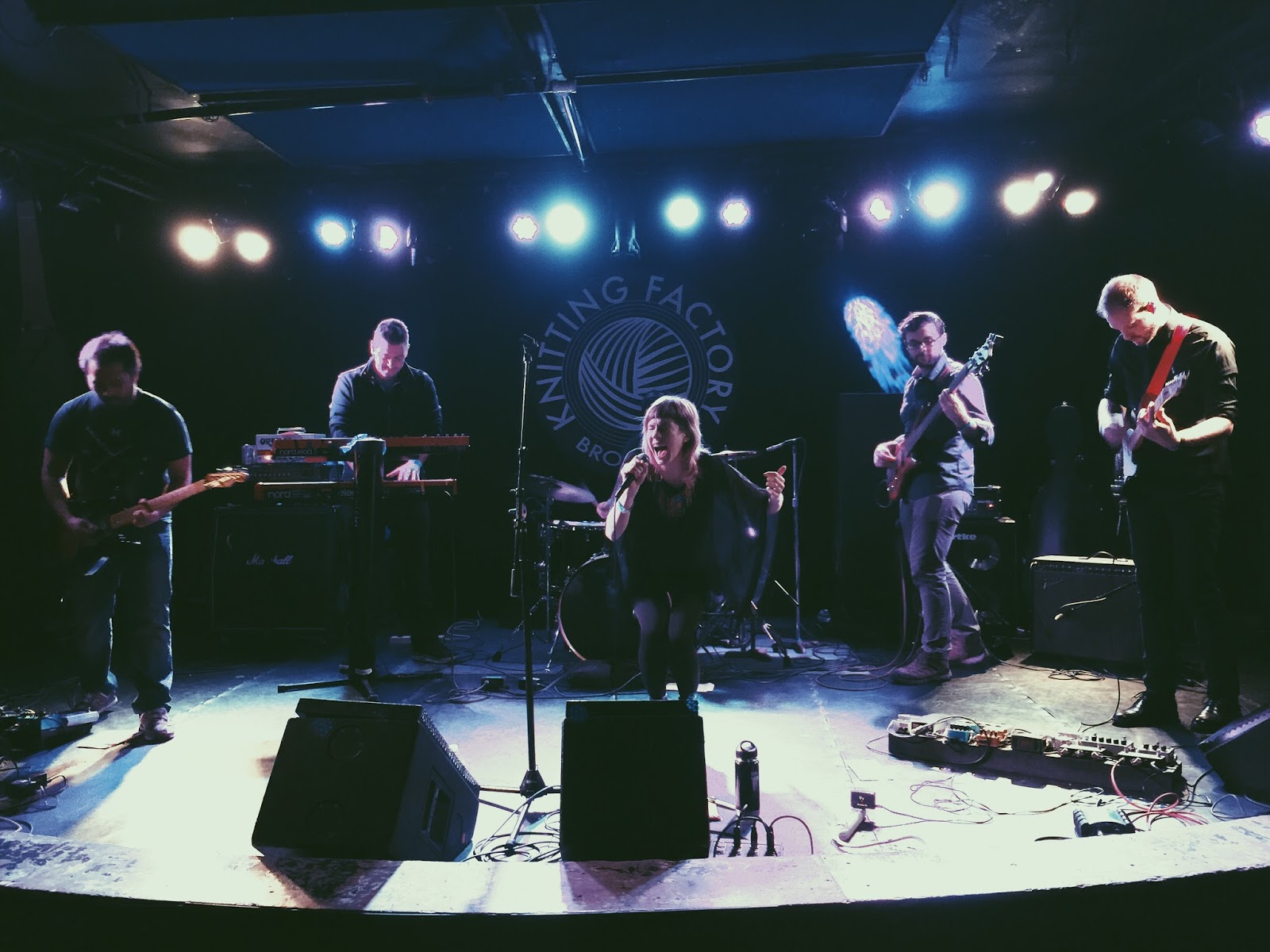
Brooklyn-based New Zealander Leila Adu released her EP Scary Love Monster last week, and while I was sorry to miss her record release show at Cake Shop, I still wanted to take the opportunity to write about her music since I was immediately struck by its originality and beauty.
A veteran composer in a variety of musical styles, Leila Adu takes timeless songwriting formulas on voyages to the terra incognita of pop. The palette of sound used here is rich and colorful, and the substance is leagues deep. This is pop that you can dive into and find yourself aesthetically and lyrically nourished. Opening with the titular track, Adu’s voice spirals up and down the scale giving melodic life to the feeling of falling down a rabbit hole of romance. She sings declarations of hard-won self-discovery, depicting an acceptance of contradictory desires. The piece travels to different landscapes, tinged with a Middle Eastern flair on the bridge and a dreamy twinkle in the atmospheric accompaniment. The repeated line, “Is there anything scarier than opening up to someone?” plays in my head long after the song ends.
“Oriental Finger Trap” is a carefully choreographed number where in the chorus, she seems bored with her predicament, literally stuck between four notes. The verses take a theatrical turn when a circus like waltz supports her fluttering voice, contrasting the ennui so much as to nearly erase it. Her soft, jazzy lilt in the last verse of the song showcases a warm, plush tone, stylistically reminiscent of 40s singers such as Judy Garland.
“Nefertiti’s Waking Dream” is where the album starts to change hues. Another New York-based band, Half Waif, coined the term ‘mood ring pop’ for their music, and a similar idea applies here. Songs shift mood subtly and guide the listener on a psychic journey. In the third track, haunting and strange patterns step up and down the scale with balletic precision. The chorus has a zombielike rhythm that gives strength to the lyrical imagery, which is particularly vibrant and frank, almost like a Modern poem.
“The Bluest Eye” is an intimate and hypnotic dream pop lullaby. It gives the sensation of being inside a music box, listening to the opera of the artist’s dream. Within the context of the album, this number is the tunnel that takes the listener from the easily accessible first numbers to the far more experimental final numbers.
“Bluebeards and Monsters,” the surprising choice for a single from this EP, appears to be the culmination of the theme of entrapment so central to the album, describing being caught in the clutches of “two Bluebeards” and soliciting advice on how to survive. Opening with urgent chanting and enthusiastic percussion, the song is soon frosted with futuristic electronic effects that eventually overtake the shaken instruments, contrasting both ends of the chronological musical spectrum. It commences with the first methods humans used to create song and finishes with the ambiance of the digital age.
The finale, “Nothing’s Going Wrong” opens with deep, fibrous orchestrations that override Adu’s pure, oceanic voice. This song is the aural equivalent of the feeling of drowning; the depression and grief in the instruments sets unsettling juxtaposition against the optimistic vocal melody. In spite of the blue nature of the song, it is a declaration of triumph. The artist has been besieged by monsters of all kinds, but she will move forward. Despite what you perceive, nothing’s going wrong.
Scary Love Monster evolves from heartfelt pop to intellectual anguish in a matter of minutes and it feels 100 percent authentic. Growing steadily more stripped down and open as it progresses, it moves like a conversation with a new lover, beginning with shimmering musings about romance and traveling to dark memories and a reassurance of her own indomitable personal grit. The motif of imprisonment and the theme of fear are present and noticeable to the observant listener and make repeat plays of the album more meaningful. This EP is a brief work of elusive beauty that develops psychologically and musically. I have listened to it countless times now and I continue to discover new insight in each song and in the œuvre as a whole. I’m hoping to catch Leila Adu next time she plays in NYC, because if her live performance is as stunning as her recorded work, then I’m a fan for life.
Scary Love Monster is available for purchase on iTunes. Listen to the title track here!
New York-based duo Loving You sent me their new track, “Nothing But Glory” for a write-up, and I’ve had it stuck in my head all week! But I’m not complaining; this catchy angel goth anthem sounds like a cross between Ellie Goulding and Massive Attack, a mix of fairy dust and dark matter.
Wintry found sounds permeate the intro and endow the number with a wild melancholy that makes it ideal for introspection. While many pop artists strive to create summer songs, this is one for your headphones in the wind and snow as you march through the urban decay with your mind focused on clawing your way to your aspirations, and fuck anyone who tries to take you down. This is a song for when you feel like a force to be reckoned with.
Haunting and cinematic with emotive timing in the layering of electronic instruments, these beats are not robotic, but like a human heart hardened to robotic nature to survive. The song’s composition becomes more intricate as it plays, like a forest that grows steadily denser as you walk through it. Indeed, the song does conjure images of bare trees beneath a gray sky in the still moments following a blizzard. The fuzzed out bass sounds like the eerie loneliness of television static, and Chris Lancaster’s strings evolve from rapid breathlessness to watery uncertainty seamlessly within a few bars. Alison Clancy’s pixie-like vocals move from states of weary fragility to airy belting with honest lyrical interpretation. The song’s chorus, the mantra of a heart broken but not beaten, stays with me long after the tune ends, forcing me to choose it when I step on the train, when I create my workout playlist. The mark of a good pop song.
This music excites me and has already encouraged me to purchase Loving You’s first EP, Tuff Love. And yet I wish they would go darker. I hear the possibility of blackholes and specters, and I hear the tremendous sorrow of their earlier work, and I want them to take the deep plunge into the unlocked potential of their sound. “Nothing But Glory” is right on the edge. I’d love to hear them go all the way over.
Vocalist Alison Clancy was kind enough to answer a few questions about Loving You and “Nothing But Glory” in particular. Below is our interview, conducted over email and edited only for grammar.
Courtesy of the band, and Safety Third Productions
HJ: How did you two meet?
AC: When Chris moved to NYC, his first job was accompanying my ballet class at NYU. He had never played for a ballet class before, and didn't really know what to do. I was standing directly in front of him, so he just followed my legs like [a] metronome and played to my every gesture. I was like “Holy fuck, this is an incredible feeling.” It created an intense creative dynamic from the moment we met.
HJ: What is your background in music/the arts?
AC: Chris is a classically trained cellist who has spent years expanding the idea of what a cello can be via electronics. He is a visceral performer and celebrated composer for dance and theater. I'm a professional dancer. I perform at lot with The Metropolitan Opera Ballet and various fashion and art projects. A few years ago I started experimenting with music. Once a I started, I was obsessively hooked, spending every free moment diving in. After dancing silently for many years, making lots of noise became really exciting.
HJ: What was your inspiration for this particular song?
AC: It's always a little elusive to me and often feels like the songs write themselves... but I think this one has something to do with balancing my very willful personality with an acceptance of fate and inevitability...
HJ: What was the process of writing and producing it like?
AC: It started as a purely cello and vocal composition Chris and I wrote in a small Cabin in northern California. When we got back to NYC we performed it for our friend Tony Long, and he was inspired to create a beat driven, fuzzed out, electronic version (hence "Grindhouse Edition" in the title). Tony is a dope producer and my favorite golden boy, so I was stoked to collaborate with him on the idea. He created a beat and synth foundation, and our friend Sonny tracked some guitars and bass. Then we had several recording and mixing sessions in our Brooklyn living room with Tony, layering in vocal, cello and electronic elements.
HJ: Do you have any shows in the US planned anytime soon?
AC: We are currently touring Scandinavia, but working on booking shows in NYC/Brooklyn for May and June and on the west coast for August.
HJ: Can we expect another track or an EP any time soon?
AC: Yes, we have an EP in the works which I expect will be released in late summer.
Courtesy of the band. Photo by Andrew T. Foster
-
I’m already planning to see one of their NYC shows! Stay posted on Loving You’s projects and tour dates here.
Rockwood Music Hall retains some of the atmosphere of raw promise that seems to have existed in the New York City of the early sixties, when American folk was starting to come into vogue among the youth and the resulting music was fresh and exciting. Stage 1, where I am this evening, is smaller than my tiny apartment and furnished with a few rickety tables and stools. Shows here are usually free, and feature the most obscure or emergent of underground artists. It’s a superb venue for newer musicians to showcase their music, and it is well-known enough to attract all types of audiophiles, no matter how snobby. Stage 1 at Rockwood Music Hall typically fits six or seven sets in an evening, starting at 6pm and going until 12 or 1 in the morning, so early birds and night owls can get their rock’n’roll fix.
I arrive in time to see the second set of the evening, Owen Danoff, a Romeo with an acoustic guitar and a smooth tenor voice a la Jesse McCartney, if you can imagine Jesse McCartney playing Bob Dylan and Paul Simon covers. His romantic original ballads are composed of gentle country-folk chords, accented with the western flair of Americana, on top of which his effeminate vocals float comfortably.
New York based band SisterMonk takes the stage at 8, setting up a multi-leveled tableau of instruments. When these Rockwood Music Hall regulars start playing, people immediately begin dancing. But how could anyone stand still? SisterMonk’s is a joyful, sunny sound that invites the audience to join the musical experience. Vocalist Kathy Deane’s full, earthy contralto blends elements of funk and galactic pop, making the listener feel connected with the music and the huge ideas painted in the melodic mantras. Deane doubles as the group’s drummer, playing spiritually derived beats on a djembe. Guitarist and lyricist Jody Rubel seems like two members of the Grateful Dead rolled in one, playing rhythmic, spacey licks resembling Bob Weir’s style, and writing in the transcendental lyrical spirit of Weir’s songwriting partner John Perry Barlow. But this music goes in even more experimental directions as Rubel strums Eastern-inspired riffs in a sultry minor key, using a sensual element of mystery to boost major psychedelic themes brimming with celestial ecstasy. There are world music inspirations in each song, calypso on the keys here, tribal drumbeats there. Their set visits all points on the musical spectrum: “Tarantula” is a mystical, shoegazey instrumental number while “Whisper” retains an indie rock element with airy vocals from keyboardist Tani Tilsner. Their single “The Call” magnifies the group’s sound to impressive size, lifting SisterMonk to the staggering heights of glam rock while dressed in hippie sensibilities. I would love to hear this band play at a summer festival or an outdoor venue where everyone has room to dance their heart out underneath the sky.
Jody Rubel and Kathy Deane of SisterMonk
James Barry’s set starts at 9, a celebratory show for the release of his album, Embrace Yourself Tonight. From the opening note, it’s clear that this guy knows how to work a stage. A charismatic frontman and a clever lyricist, Barry holds his audience captive with an almost lunatic energy focused into recreating some of rock’s most famous postures, such as Pete Townshend’s leaps into the air, and a hint of Chuck Berry’s duck walk. His catchy, radio-ready tunes have punk’s length and uptempo attitude, but they share a lyrical gene with classic rock of the mid-70s. Barry’s voice, on the other hand, is neither rock nor punk, but high and theatrical, capable of holding attention over an excellent band and all other nonsense in the room and forcing you to listen.
James Barry
After James Barry’s set, some guy hits on me and I decide that the venue is too small for me to stick around after that shit, so I head out. But first I ask Jody Rubel, the guitarist for SisterMonk, if I could possibly interview him for Hydrogen Jukebox. He asks me if I liked the music, and I say yes, thinking about all the glowing things I can’t wait to write down. Perhaps sensing that I’m a good witch, he agrees and tells me that SisterMonk plays at Penn Station every Friday night between 8pm and 11pm. I’ve never interviewed a musician in the subway before! Awesome!
So, Friday night I head out to Penn Station wondering how long it will take me to find them, and it only takes about five minutes. I find them in front of the McDonalds, and ask Jody if he remembers me from Rockwood Music Hall. He does, and we start talking, even though he still seems a little skeptical of me and my recorder. I start by asking him about his influences. “That’s such a loaded question…I did grow up with all that rock stuff in the eighties and I was very influenced by that, but then I had a radical departure from Western culture…I graduated college and became completely disenchanted and felt very disenfranchised from everything that was going on in our culture, and I did a lot of traveling in South America, and I actually ended up loving, and even worshipping the music of Bahia from Brazil. So people like Milton Nascimento, and Caetano Veloso, that whole Tropicalismo movement really entranced me for a couple years. And also the music of Bach, different kinds of jazz, I started really opening my ears and listening to a lot of different things in my early, early twenties.”
When asked more about his travels abroad, he starts the familiar narrative of the conflicted student. “I studied anthropology in college, and I started a program [in which] I was going to do visual anthropology and after only a couple months into it, I was like, this is not for me. My real interest in anthropology is learning about other cultures and traveling…So I started traveling and I came upon these towns and little villages in the Amazon, where everyone was carrying a guitar and playing music, and I loved how there were guitar shops everywhere, and I wasn’t even playing any music at that time, but I became very intrigued with music as a way of life in tribal culture.”
So after all that rich inspiration, how was SisterMonk born? Jody says it began in Ojai, California, where he, his brother, and singer/drummer Kathy Deane wrote songs about the spiritual teachings of Jiddu Krishnamurti. “We ended up on this zen kind of commune and started really getting into music, writing songs, and living in an army tent. Then me and Kathy ended up living in a community where we were farming, and we said that’s where the idea for SisterMonk came about. A lot of people had djembes, and it was a pretty strong tribal culture, and [those] are kind of the roots for this band.”
SisterMonk at Penn Station
Encouraged by a friend and fellow musician to share their music with the East coast, SisterMonk eventually headed back to New York City to give our drearier denizens an audible taste of California sunshine. So how do they define their sound now that they’re a fully-fledged band with several albums under their belt? “The world element is really important. I know my guitar has blaring, classic rock tones to it, but to me that djembe, world, African, even Middle Eastern timbre is so vital to how the songs are written, how they’re built. Also, the lyrics are really organic.”
What seems truly organic is the songwriting process Jody describes for me. “I listen to the drum. The drum listens to my guitar. The music forms, and the music tells me what the song is about lyrically.” He cites W.H Auden and William Blake as poets who shaped his literary mind early on.
When asked about his favorite venues in New York, Jody doesn’t hesitate. “Rockwood Music Hall. Because unlike some other clubs, they really focus on the music, so it’s not a popularity contest so much as, a good band gets to play here. It’s not like some of the other places where they cater to who has a big crowd and how many bands you can squish in in an hour, just an obvious moneymaking belt. Rockwood doesn’t feel like it’s about that at all. They always have good music there. There’s always good music there, and people know where to go. Sophisticated audiences that appreciate music…Rockwood is a really bright spot in a sort of depressing scene where there’s a lot of promoters who are looking to book your band not on the basis of your music, but on the basis of how many people you can bring [in].”
Beyond the politics of local venues, SisterMonk has big plans for the year ahead. Jody tells me they are working on another album, and they would like to do more touring during festival seasons. “I would love to see us warming up for larger bands in stadiums, and just playing lots of festivals, not just in the states, but around the world.”
Hopefully SisterMonk plays a festival near you sometime, dear reader, but in the meantime, check out the song below and sample all their music here.
The crowd is thin at the Bowery Electric on this wet Tuesday, but the folks who made it out are determined to have a good time in spite of damp socks and train delays. This East Village venue has two floors, and I came to see the show happening downstairs in the Electric Room, where the combination of gritty exposed brick and a swanky full bar on the mezzanine gives the space a funky vibe attuned to the personality of the neighborhood.
First in tonight’s lineup is Everything Falls, an alternative rock band from Springfield, New Jersey whose biker bar brand of music fits the same bill as Seether, and other heavy alternative bands of the mid-2000s. Everything Falls strikes a nice balance between light and dark by pairing thunderous, bloodthirsty drums with fluid, flowery guitar solos, and steely, rigid bass riffs with impassioned vocals. Guitarist Kenny Sheldon plays melancholy, blues-tinged notes that dance up and down the scale, adding a touch of raw truth to what otherwise might be a too-rehearsed sound. Everything Falls is a highly polished, radio-friendly group, and almost too well-oiled for the rowdy crowds they’re sure to appeal to.
Up next is New York-based punk trio Thundera, whose bedroom confessional style lyrics are potent and piercing, parallel to punching drums and razor sharp guitar riffs. Thundera seems to have come here straight from a 90’s riot grrrl festival and they retain all the best features of that subgenre: stark lyrics discussing taboo subjects, chantable hooks and hummable tunes, and vocal quality more dependent on personality than on tone or technical dexterity. Vocalist Rissa Aponte hops and struts around the stage like the outsiders’ heroine from your middle school dreams, and her emotional range far exceeds her vocal range, making her an ideal punk singer. She bubbles with anger in one number before melting into romantic wistfulness in another, an accepted vulnerability written on her face and ingrained in her dancing that authenticates her lyrics and captivates her audience. “Cool” is a hard-hitting anti-anthem in the vein of Bikini Kill and Garbage, while the largo tune “Sally” is enchanting and beautiful without fitting any specific style. “Sally” is the one moment of Thundera’s set where the punk element fades almost completely, but it is this moment of versatility that reveals how special they are. The remainder of their stage time is spent firing the small audience up. Bruni Lee plays her drums in the same ferocious, tinny style as Tobi Vail, a constant, hungry pulse that underlines every word Rissa sings. Lead guitarist Marianna Cantos brings a touch of pure hard rock to the group, playing rich, languid riffs that overlap each other like ocean waves rather than the rapid, staccato chords so typical of the punk sound. Her playing has a touch of the early 70s, and the dense, metallic phrases oozing from her instrument remind me of Ritchie Blackmore’s work in Deep Purple. Thundera lays down a solid performance and as they pack up their instruments, I’m wishing their set was longer and wondering when their next show is.
Drummer Bruni Lee and Singer Rissa Aponte playing "Sally"
Following Thundera is Freya Wilcox and the Howl, a Brooklyn-based group led by Australian singer and guitarist, Freya Wilcox. From the first note, this is old fashioned heavy metal, descended from Led Zeppelin, Black Sabbath, Janis Joplin, and all the godparents of rock and roll. Their energy is epidemic. Their sound weighs a ton and soars like a rocket ship. No one can possibly stand still as they fill the room with iron vibrations, but Freya Wilcox rocks harder than everyone, head banging furiously as she strangles screeching rhythms from her guitar. Her raspy alto voice has a bluesy texture nuanced by real anger, and the band’s cover of “Rhiannon” seems to ring truer in her chain smoker’s tone than it ever did in Stevie Nicks’ honeyed one. Even slower numbers are thick with rage and laden with warlike drumbeats, courtesy of CJ Dunaieff. This is the kind of mutable rock that would enrapture an audience in a stadium as much as an audience in a dive bar.
Freya Wilcox and Craig Shay
Unfortunately, the Bat Signal shines in the sky, and I have to miss the last band of the night, Mighty Kind. But I refuse to leave and save Gotham without talking to the ladies of Thundera, who are nice enough to consent to an interview. Below is our conversation, conducted over email and edited only for grammar.
HJ: Tell me about the moment you discovered punk rock. How did it change you?
Rissa Aponte (singer): I can’t really remember the very first time I heard punk rock, it might’ve been longer ago than I recall and I just didn’t realize it was punk at the time, but I do remember the first time I heard Bikini Kill, and they’re the ones that really got me into punk rock music. I was in my basement doing a chore or something and playing music from YouTube on my laptop so I wouldn’t get bored. I saw “Rebel Girl” as one of the recommended videos and clicked it, and I was floored. I loved everything, the music, the lyrics, the attitude, the song’s power and message, all of it! I had never heard anything like that before, and I kept replaying it. From there I researched the band and saw a picture of Kathleen Hanna, the lead singer, wearing a T-shirt with The Clash on the front, so I looked them up and loved their music, too, and it kinda snowballed from there.
Marianna Cantos (lead guitarist): The first time I ever really heard about punk rock was when I read a biography about Nirvana. The book mentioned how Kurt Cobain was influenced by punk rock when he started out playing in bands. He mentioned he was into bands like Bikini Kill. It didn’t occur to me to look up Bikini Kill until I joined Thundera. That’s when I really started to explore punk music. Bikini Kill, The Sex Pistols, The Stooges, Misfits, all different styles of punk, but they all have that raw attitude that I love from a band. They weren’t trying to be perfect, they just wanted to be heard.
Bruni Lee (drummer): I can’t really pinpoint the first time I heard punk. I’ve always been into all kinds of music, so [I] was probably listening to it before identifying it as punk. I do remember the first time I head Horses by Patti Smith. I heard this story unfolding alongside a barrage of sounds being pushed forward by a topic I had never heard addressed that way in music before. The imagery, the poetry, the honesty. It was amazing! I loved it. I also remember hearing “Rebel Girl” by Bikini Kill in some movie I was watching. I was spellbound. I felt a heat rising up in my body. I wanted to scream. I wanted [to] move. I wanted to do something! It made me want to take action!
HJ: Who are you individual influences, in terms of creative style and musical technique?
R.A: Lyrically, Brandon Flowers from The Killers inspired me to start writing songs of my own, since I admired his writing so much, but we have very different writing styles. He uses a lot of metaphors and imagery in his lyrics, while I tend to write more straightforward and direct, which is inspired by Joe Strummer and Mick Jones from The Clash, and Bruce Springsteen. Vocally, I really like the style of Alison Mosshart from The Kills. She can sing really hard rock songs with lots of grit and attitude, but [she] can also sing slower and more melodic songs really well, which is what I try to do.
M.C: I’m influenced by Slash of Guns N’ Roses and Kim Thayil of Soundgarden. They are both very talented and have distinctive styles. Kim Thayil’s tuning, heavy sound, and catchy riffs are what got me into grunge. I try to incorporate that heavy style and add some melody to it for our music.
B.L: I love drummers/musicians who have a sense of power in their playing, not in the physical sense, but in their purpose and delivery. I love drummers who know when not to play and how not to overplay. I truly appreciate a drummer who can play something simple or complicated and make it interesting without losing the basis of the song. John Bonham is a great example of that. He’s my top pick for his creative instincts and his groove.
Left to right, Marianna Cantos, Bruni Lee, Rissa Aponte
HJ: What is your favorite song that you’ve written? What is your favorite cover to play? Why?
R.A: I think “Shake It Off” will always have a special place in my heard since it was the first uptempo song I had written, before the others that I actually thought were really good- haha! It definitely inspired me to keep going. But another song I’m really proud of is “Sally.” When I wrote the lyrics and the rhythm guitar part I thought it was pretty good, but when Marianna and Bruni added their parts, I loved it, and when we played it like and I saw people singing the chorus to themselves for the first time and enjoying it, that’s when I realized the song had something special. As for the covers, I really enjoy when we play “Cherry Bomb” by The Runaways. It’s just a lot of fun to play, sing, and dance to, and the crowd gets really hyped when we perform it.
M.C: I haven’t written any lyrics, but some of the guitar parts I’ve come up with for our songs, like, “Gettin’ By” and “Thundera” have been my favorites so far. I enjoy the riff for “Gettin’ By,” and really like the guitar changes in “Thundera.” My favorite song to cover is “So What’cha Want” by Beastie Boys. I really enjoy Rissa’s vocals on that song, they’re so in your face. I love how Bruni’s drums sound deep and bassy. The guitar parts are simple and fun to play, too.
B.L: I’ve written a few songs that we haven’t played yet, and there are some songs that i’m still writing, so it’s hard to say. The one song I’ve written that we play is “Thundera,” so I guess that’s my favorite for now. I like how it’s kind of a manifesto about who we are. It’s hard to pick just one cover. I really like all the covers we play. I really love playing “Sabotage” and “No Sleep Til Brooklyn” by Beastie Boys, and “Deceptacon” by Le Tigre. Beastie Boys are cool because they’re rap and have a fun vibe. It’s also fun to play these because people don’t expect us to cover their songs. After we play them, people are like, “Whoa. Didn’t see that coming. It was awesome.” I love the song “Deceptacon.” I’ve played this song on my iPod so many times. It’s such a dance-y/pop song. It really puts me in a good mood. Plus, it’s Kathleen Hanna. Love her!
HJ: How are you affected by the heavy reliance on social media needed to promote underground music these days?
R.A: I know that having social media is essential now if you want to promote anything you’re working on, whether you’re a musician, artist, writer, filmmaker, etc. Having platforms like Facebook, Twitter, and Instagram has definitely helped us extend our reach in gaining more fans online, but it’s even better when fans that found out about us, either though our page, a shared post or a hashtag, message us to let us know that they really enjoy what we’re doing, or better yet, come to a show! Finding out about a local band online that you end up liking is fun and exciting, but it would be great if more people acted on that initial interest and came out in person so see bands perform and brought friends with them, or even bought some band merch. I think bringing out fans from the digital world into the real world is pretty hard to do nowadays, but it’s definitely possible. It just takes more work than it did in the past.
M.C: Social media is very helpful. It makes it easy to share and communicate with others. We’ve reached lots of fans through Facebook, Instagram, Twitter, and Reverbnation.
B.L: Social media has been very helpful in getting the word out about our music, shows, and presence on the scene. Everyone is on some form of social media so it’s important to reach out and connect through as many avenues as possible. Any indie artist trying to make a name or sustain a name must be plugged into social media. Having said that, it is a challenge to be “seen” amidst so much activity on social media. You really have to work on creating messages/posts that engage the audience and cut through the constant flood of information.
HJ: What are your thoughts on the punk scene in New York City?
R.A: Punk rock is definitely not dead in NYC! There are a lot of punk bands that we’ve played with that are awesome, but I think the ones that stick out to me are the bands with female and/or queer musicians. Seeing them perform onstage and hearing their songs is always exciting and a good time, and also really important, since I think inclusion in punk rock is a promise that isn’t always fulfilled, both onstage and in the audience. But when you see ladies and queer musicians playing onstage, fully supported by everyone in the room, it’s a great thing to be part of.
M.C: I really enjoy the punk scene in NYC. All of the people we’ve played with have been awesome. There’s a mutual understanding with punk rockers. We want to be heard and we want people to understand us through our music.
B.L: We have been really fortunate to play shows with bands we love who support us and whom we support. It’s especially great to see such a thriving female/queer/LGBT punk scene here in NY. I love playing shows or going to see shows where everyone is unified by the same principle of acceptance and encouragement for artists representing different walks of life. Punk is alive and well in NYC. There are so many great shows to go to, it’s hard to keep up!
--
Get a taste of Thundera’s wicked style here, and keep an eye on them with Facebook and Reverbnation!
Cake Shop is one of my favorite venues in Manhattan. On the first floor, it appears to be like any other brunch bar in the Lower East Side, but downstairs where the bands play, it looks like a burlesque dive. The space is tiny, dark and dusty and the stage looks like it was lifted from a high school prom around 1980. The bar has a nice whiskey selection and the music is usually well worth the cover. Some of the bigger names that have played here include Warpaint, the Dirty Projectors, and Spoon.
The first band on the bill tonight is Sly Moth, a local pop punk quartet whose punk side leans to the grungier aspects of the genre, reminiscent of bands like Bratmobile and Bikini Kill. In fact, singer Dani Newman has the same intense, childlike tone as Kathleen Hanna. But the real attention grabber from the start in this outfit is drummer Jonathan Levy, whose incendiary playing is the true source of power in Sly Moth. Levy moves his arms like an orchestra conductor as he plays, pounding out beats with passionate precision and maintaining a wellspring of energy throughout the set. Bassist Xiao Mei Hu looks zoned out in her corner of the stage as she slays tuneful melodies usually expected from the guitarist. Hu picks carefree pop lines charged with determination, not unlike Jenny Lewis’s bass playing in certain Rilo Kiley songs. Sly Moth’s diverse sound is frosted with reverberating psychedelic interludes from guitarist Stephen Ericson, giving them a softening touch of acid rock that makes their sound cohesive.
Sly Moth, From left to right: Xiao Mei Hu, Jonathan Levy, Dani Newman, Stephen Ericson
I came to Cake Shop tonight specifically to see the second band, all boy/all girl, because I bought their first EP, Trophy, last week and I’ve listened to it almost every day since. Usually a seven-piece ensemble, tonight is a special stripped-down set with only five members. In trying to define their experimental pop sound, I arrive at the conclusion that they have turned rock opera into a legitimate genre. Delicate schoolgirl harmonies sung by Danielle Lovier and Jessie Rogowski are juxtaposed against gritty lyrics and a heavy electric bass. Lovier manages to coax angst out of her ukulele, and the whole band dances and sways exuberantly throughout the show. All boy/all girl has the carnival theatrics of groups like Edward Sharpe and the Magnetic Zeros, and the sweet, bubbly flavor of 60s girl groups. Their sound gets sharper and denser as the set goes on, and their explosive rendition of “Glitter” brings the house down. The magnitude of so many rapidly played strings combined with Joey Campanella’s formidable drums creates a wall of sound so thick that when Lovier’s lilt transforms into an electrifying banshee wail, it sounds like the trumpets of Jericho. Their style oscillates between indie-acoustic and folk-spiked electric pop for most of the set, always in the campy vein of musical theatre. Lovier and Rogowski are radiant performers who know how to capture an audience.
all boy/all girl, from left to right: Josh Curry, Joey Campanella, Jessie Rogowski, Danielle Lovier, Nick Rahn
The third band of the night is How Sad, a dance music group from Montreal, and they set the stage with so many keyboards, it looks like a music shop. The abundance of instruments and players makes it nearly impossible to tell where any sound onstage is coming from. The creation of mesmerizing bandleader Harris, How Sad gets the room moving with meticulously synchronized layers of simple beats and universal melodies that weave together and result in unique and danceable numbers. Some of the songs sound like they belong on the soundtrack to any John Hughes film, and some, like “Hot Blur,” are summer anthems that beg to be played at a music festival. This is unapologetic, celebratory pop, and proof that the musical virtues of the 1980s are still alive and well.
The last band on the bill is Nashville-based Keeps, an ambient rock outfit consisting of three guitarists and a drummer. Keeps traverses dreamy planes of adagio riffs and frenetic war zones thick with metallic vibrations. Oily licks on top of electropop beats give the music a timeless quality that mixes some of rock’s best features from several decades and different subgeneres. While Keeps is a well-rehearsed group and enjoyable to listen to, they don’t have the same versatility as the groups that came before them tonight. It’s hard to tell one song from the next, and they come off a little one note, albeit, a good note.
Before leaving Cake Shop, I catch Danielle Lovier of all boy/all girl and ask if she would be down to do an interview for Hydrogen Jukebox, since their set was such a blast to experience. Below is our interview, conducted over email and edited only for grammar.
HJ: Tell me a little about the formation of all boy/all girl. I know it started with you and double bassist, Nicholas Rahn. How did the rest of the ensemble come together?
DL: Nick and I made some demos and put up an ad on Craigslist and found Jessie and our viola player, Hannah. We found a few others, but over the years we've switched out some key players. Josh is one of Nick's childhood best friends. Joey we found through a mutual friend and Susan came recommended from our last cellist.
Press photo by Ali Brant, courtesy of the band
HJ: Can you tell me a little about your songwriting process? Your compositions seem to have more in common with what’s on Broadway than in Bushwick.
DL: Nick is the main songwriter/arranger. We live together so I help shape the songs from their infancy (mostly just saying no until I like it). Usually we make a demo and send out sheet music to the rest of the band. At rehearsal, we flesh it out a little more and people add their own twists on the existing parts.
HJ: Your sets are really fully-fledged performances! Do you have background in theatre, or formal training in any of the performing arts?
DL: You caught me. I was a musical theatre major at UArts in Philly.
HJ: Your music is very vocally demanding. How long do you warm up before a show? Do you follow any particular warm up technique? How do you care for your voice between shows and practices?
DL: I wish I was better about this. Usually on the day of a show, I'll have sang through the set list and I try to remember to do some sirens.
HJ: As an artist, what are your favorite platforms to sell your music? i.e. iTunes, BandCamp, etc.
DL: We've made our music available on pretty much every possible digital platform. That being said, we believe strongly in physical media. We prefer people buy a cassette, CD, or vinyl. For our digital downloads on our last EP 'Trophy', we handmade little trophies that had a scroll in it with a redeem code.
HJ: You’ve toured extensively, in the U.S and abroad. Tell me about your craziest experience!
DL: We played a music festival in a small town in the Netherlands called Westerwijtwerd. I think the population is 100. I'm pretty sure every single person that lived there came to see us. Apparently, the last American musician who had played there was Bob Dylan. It was so much fun and we really felt like super stars.
HJ: I don’t see any upcoming shows on your calendar. Are you heading back to the studio? What’s next?
DL: We actually just got back on Sunday from recording a full length album at Machines with Magnets in Rhode Island. We're super happy with how it turned out and can't wait to release it, but we're now recovering after a few exhausting weeks. We probably won't play another show until early spring.
-
I hope I can catch all boy/all girl's next show, whenever that may be, because their set at Cake Shop was such a good time. In the meanwhile, give this song a listen, and check out their latest music here!
It’s an icy Wednesday night and I’m back in Bushwick for what promises to be an evening of mellow folk rock and softer pop sounds at the Silent Barn, one of the remaining DIY spaces in this rapidly changing neighborhood. The cover charge for shows here is usually around $8, and it’s worth it; the musicians who play here tend to be innovative and have great respect for their craft. There is an outdoor area for seasonable months, but tonight’s event is inside the gallery. Walls covered in abstract designs lend to the adaptable nature of the venue. An ominous looking black triangle over the center of the stage brings a psychedelic vibe to the room, and shifting blue and rose lights give the illusion of being in an aquarium.
Fieldings is the first band of the night. The brainchild of Australian producer Lucinda Hearn, Fieldings has the crystal, dreamy sound of 90’s alternative rock laced with pop. Shining, broad notes from the guitar hang in the air and drift by like smoke long after they’ve been picked. This brand of rock is romantic without being precious. It is innocent and sensual, like falling in love on acid. Hearn’s voice whips up and down the scale and weaves around backup vocalist and keyboardist Melodie Stancato’s birdlike soprano tone with abandon. The stripped down pop style of the Smiths-like guitar gives Fieldings the raw sentimentality of teenage lust in all its simplicity and urgency. Their music would be a fitting soundtrack for a high school hipster’s make out session. Fieldings has a show on February 24th at Our Wicked Lady, if interested readers would like to know.
Swoon Lake is the second act, also featuring Melodie Stancato, this time on lead vocal as well as keys. Fluttering three part harmonies climb like ivy around an eerie violin played by Aviva Skye, who seems to play exclusively in the minor key. Swoon Lake call themselves “spooky folk” and it’s an apt label as far as vocals are concerned. The drums are pure rock and roll and even the violin sounds dipped in grunge. Ryan Surrano and Paul [last name unknown] switch roles as drummer and bassist throughout the set. Their songs evoke a wintry melancholy, one minute delicate as a snowflake and then heavy as heartbreak. Stancato’s voice has the same rich yet airy quality as Ingrid Michaelson’s, and the focus of their repertoire does seem to be on the vocals. The synth, violin, bass and drums all seem to support and showcase the impressively sung polyphonies, but what really knocks the listener out is when the weight of all the parts of this ensemble collide explosively at opportune moments in the composition. The music gets more haunting as the set goes on and by the final number, Swoon Lake is deep into some experimental discordance that solidifies the ghostly rock sound they have cultivated.
Swoon Lake. From left to right, Paul [last name unknown], Ryan Surrano, Melodie Stancato, Aviva Skye
Half Waif is next up and I’m so immediately drawn into their charm that I forget to take any notes for most of their set. The project of singer and keyboardist Nandi Rose Plunkett, Half Waif is a three piece group whose euphonic tunes don’t fit neatly into any one genre. They are cinematic and poetic. Plunkett has a gift for song arrangement, as the pieces are formulaic without predictability. Each song has its own mood and the set list seems to be more of a carefully designed musical journey than most concerts I’ve been to in a while. Plunkett’s stage presence is magnetic and captivating. She manages to embody her songs entirely, and her voice is charged with layers of palpable emotion while being completely liberated. She performs with stunning clarity, as well as the theatricality and diction of a veteran actor. Her piano accompaniment ripples with the misty air of new age music and there is an ethereal quality to her playing. Bassist Adan Carlo gives the group an instinctive pulse that adds an element of primitive sexuality to an otherwise highly cerebral sound, and drummer Zach Levine’s poppy beats keep the ambience optimistic even when the lyrical content is more serious. This is a well-rehearsed and highly disciplined ensemble that manages to not only maintain spirited energy throughout their set, but seems truly excited to share their music. Plunkett’s otherworldly, featherlight voice lingers in my ears long after her songs have finished, and I know I’m going to buy their EP before I get on the train.
Half Waif. From left to right, Nandi Rose Plunkett, Adan Carlo. Zach Levine on drums in the back.
Unfortunately because the show started so late, and I do have to get on the train for a very long ride, I am forced to leave before hearing the final band on the bill, TIGUE, but I hope to catch them another night. Before I head back to my corner of Brooklyn, I thank Nandi Rose Plunkett for a beautiful set and ask if she’d be down to do an interview for Hydrogen Jukebox. She’s as warm and energetic offstage as she is in performance and she agrees to chat with me. Below is our interview, conducted over email, and edited only for grammar.
Q. Your work defies typical classification, beyond perhaps the singer/songwriter category. How would you define Half Waif’s sound?
A. It’s bits of a lot of different things. We recently came up with the term “mood ring pop” and I think that fits it pretty well. But at the heart of all the layers are just songs, and while I don’t necessarily identify as a singer-songwriter anymore, that’s where I started from and I hope to always have good songs at the center of interesting sounds and textures.
Q. Who are your strongest musical influences?
A. Early on, it was Tori Amos all the way. Then Bjork, Radiohead. In college, I was into early 20th century composers and their use of harmony and tone color – Debussy, Stravinsky, Messiaen. More recently, strong female singers and producers like iamamiwhoami, Joanna Newsom, Weyes Blood, My Brightest Diamond, St Vincent, and Lydia Ainsworth.
Q. Your lyrics are quite poetic. Do you attribute that to any specific literary influences?
A. I love to read! Especially things with really juicy imagery, like Lorrie Moore, Karen Russell, David Mitchell, Milan Kundera, Sylvia Plath, Pablo Neruda. Whenever I’m feeling particularly stuck or burned out on music, I turn to these writers and they sort of kick-start the wellspring again.
Q. How do your heritage and upbringing play into your composition? Your performance?
A. I don’t overtly reference my heritage/upbringing but I do think it comes out in ways. People sometimes say that I sound Irish when I sing. I grew up listening to a lot of Celtic folk music, which is lilting and heavily adorned – not totally unlike Indian classical music. Beyond that, growing up in a multicultural household in a very homogenous area always gave me a sense of uniqueness that I clung to as a way of ‘being somebody.’ My mother, an Indian woman, was a refugee from Uganda and our family is scattered all over the place; our family history is so fluid. That feeling of placelessness – and yet having so many homes – was the source from which this project grew.
Press photo by Celina Carney, courtesy of the band
Q. You’re releasing a full-length album in the spring! How have you changed, musically and lyrically, since KOTEKAN?
A. Yeah super excited to share this new material! The whole process for recording these two albums was very different – KOTEKAN was recorded in a studio, Probable Depths was more DIY. Many of the sounds on Probable Depths were sampled from the house I grew up in, in Massachusetts. So there’s perhaps a more organic, earthier feel to it. Lyrically, the last album was written when I was living alone whereas the newer one comes at a time when I’m living with someone, sharing my life with someone – so there’s a difference in how relationships are talked about and explored.
Q. Your band is gaining some traction. You’ve made several EPs, videos, and you’re starting to do more traveling for gigs! What are the challenges you’re facing now, and how do they differ from the challenges you experienced when you began Half Waif?
A. Half Waif has evolved so much since it began as my solo project 4 years ago – different band iterations, different influences and sounds. The challenge for a while was how to find the right band, and did I even want this to be a band, or did I want it to just be me? And what does “me” even sound like? For the first time, I really feel like it has become a band made up of these three specific people, and it’s these three people’s sounds that are influencing the music and pushing it forward. I’m still mostly writing the songs, but the process is becoming more collaborative, because I trust Zack and Adan more than anything, and really value their creative input. The challenge now is just to write the best music we possibly can, keep refining our live arrangements, and find what sounds like “us.”
Q. What is your favorite song that you’ve written so far, and why?
A. My favorite song is a super new one that will be on our next EP. It’s called “Magic Trick.” It’s the shortest song I’ve ever written, only two verses, but I feel like I said everything I needed to say in those verses. The arrangement is built upon a sample of me singing with my friends in an echo-y room in California – I made it into a keyboard and it creates this really cool effect of voices sliding around in harmony. Using found sounds to make synths and beats is one method I’m using more in an effort to create unique, space-and-time specific music.
Q. Do you have any favorite venues to play in Brooklyn or Manhattan? Any favorite local bands?
A. Fave venues – Shea Stadium, Palisades, Manhattan Inn, Baby’s All Right
Fave bands (taking local to mean NY/Philly/NJ) – Palm, Alex G, Long Beard, Fraternal Twin, TIGUE, Mitski, Big Thief, Zula
Q. What are your plans after Probable Depths debuts in May? What’s the next step for your band?
A. We’re going on a tour out to the Midwest and up through Canada and back in late May/June. And then we’re going to start working on the next EP!
-
Half Waif has scheduled their record release show for Probable Depths on May 12th at Baby’s All Right.
Watch their trippy video for "Ceremonial" here, then find their music on iTunes and BandCamp!
It’s a rainy Monday night and the crowd at Shea Stadium in Brooklyn is thin, which is surprising since the evening’s lineup is promising. The twenty-five or so who did brave the drizzle stand in clusters of three and four, chatting quietly as pre-show visualizations resembling a horrific 80’s acid trip loop on a screen above the stage. The atmosphere is more like that of a low-key art gallery than a concert, and perhaps this is fitting, considering the style of rock that’s being featured here tonight.
At 8:30, Lost Gloves takes the stage and kicks off the show with a pop-punk number that reminds me of every garage band I’ve ever known, but the sound evolves rapidly through a series of quick songs. Fuzzy vocals throughout the set lend to the punk vibe, as well as the fact that the tunes are catchy and danceable. The influence of early 2000’s alternative is also evident. Lost Gloves sounds like Green Day one minute, and Phantom Planet the next, and they maintain the playfully furious energy associated with that era, remaining as frenetic as the neon visuals behind them. The 4 piece ensemble becomes more focused on the synthesizer as the set goes on, the music growing denser and trippier until the synth is as prominent as the bass. Lost Gloves finishes strong with a whimsically shrieking chorus from all instruments, rabid drums, and a fiery pulse that leaves the audience wide awake, and ready for the next act.
Howth immediately changes the mood, starting their set with a light song that feels like cosmic rain and begs for an outdoor venue. CSN-like vocal harmonies are complemented by airy guitar; the music is melodic and spacey. But the second number is a sharp contrast. Hard and fast-paced rock that cleverly switches flow from staccato to legato every few measures. Giving this performance their all in spite of the slim turnout, Howth showcases their expertise in the lighter elements of American rock with rolling rhythms and shapeshifting synchronicity reminiscent of Bob Weir and Phil Lesh. Long periods of instrumental play punctuate the set. Arresting allegro riffs are interspersed with sexy licks that wouldn’t have been out of place at the Avalon Ballroom in 1968. This is the first night of Howth’s February residency at Shea Stadium, and from the sound of it, I may have to come back another Monday and catch them again. Their music blooms throughout the show and and the last song is pure adrenaline, the kind of tune that makes me want to drive down an open freeway in the middle of the summer with the windows down.
The room is thick with anticipation as Oracle Room sets up their equipment. Around me fly buzzes and whispers about their previous shows. “Have you seen these guys yet?” “They’re really good.” The hype is not undue; I bought their 3 song EP, Have Everything, last week and have been listening to it constantly, sliding the titular track between Radiohead and Halsey songs on my playlists. The room goes quiet as the band takes up their instruments and singer/songwriter Alex Nelson adjusts the microphone a final time.
Left to right: Ian Milliken, Zach Fisher, Alex Nelson, Derik Lee, Justin Gonzales
Oracle Room opens with a rich, intense instrumental crescendo that rockets the psyche to an astral plane. Ian Milliken, guitarist and cellist, takes his cello bow to his guitar and fills the room with layers of fibrous harmony. The sound unfolds like a different dimension, and the first two numbers are dark and penetrating. Brief, poetic lyrics tap into the vulnerable subconscious. These songs invite themselves into your brain, curl up and make a home there. Alex Nelson’s mezzo-soprano voice is pure starlight; her lark-like melodies reach the sky and flutter back to the stage with a vibrato subtle as a heartbeat. As mesmerizing to watch as to listen to, she moves back and forth between kneeling on the ground as if praying to entranced dancing as if possessed by some muse. Drummer Zach Fisher provides grounding drumbeats that sound rooted in ancient rituals, and the complexity of the changing rhythms is highly impressive. There are so many sounds occurring in this 6-piece ensemble that it is difficult to tell who is contributing what, but the result is remarkable. Nelson’s vocals soar over the fused harmonies of the strings behind her, high notes dancing like a brook over so many smooth pebbles. It’s the kind of performance that leaves one breathless and inspired, overcome with the sensation of aural beauty. I feel sorry for anyone who missed this show because of the rain.
After the show, I approach Nelson as she is helping clear the stage and ask if I can possibly interview her before she is playing sold out shows across the country. She kindly agrees. Below is a transcript of our interview, conducted over email, and edited only for grammar.
Q. What are the roots of your inspiration to write music?
A. My first guess is genetic, but the roots are very deep. My dad is jazz guitarist and composer, and his father played guitar as well. My dad writes A LOT of music, it's hard to keep up with him. We had a piano in my house growing up, and I remember writing songs at a very early age, and recording them on cassette. I started choir and violin as soon as it was offered in school and continued until I graduated. At some point people acknowledged I was a good singer in the classical/ musical theatre realms so I focused on that and didn't think more about writing my own material. I thought for a while I would be a jazz singer, and there was a point where I realized I was always trying to emulate some sort of voice - jazz, classical, musical theatre, whatever. I didn't know what my own voice was and what my own voice would sing. In my early twenties a good friend of mine sent me a guitar melody one night and I quickly wrote a melody and lyrics to it. It turned out really beautiful, and it was the beginning of me rediscovering myself as a songwriter. It was one of the first songs I performed in my first band as a front woman. It was like picking back up from when I wrote songs when I was a child after a long hiatus. I haven't stopped since. Someone once said creating music is like an itch, you have to scratch it.
Alex Nelson, courtesy of the band
Q. How does playing a live show differ from creating music in the studio, in terms of preparation and performance? HJ
A. I come from a background of live performance in music and theatre. It was really what fueled me to do music for so many years. It's quite a rush. I feel extremely comfortable on stage, it's probably where I feel the most comfortable. It's just a helluva lot of fun, and it's extremely rewarding when an audience resonates with the performance. In terms of preparation, I'm quite a stickler. I really don't believe in winging it, even improvisation comes from a place of discipline. I like to be extremely well rehearsed, and expect whomever I'm playing with to be as well. There is so much talent in NYC, one cannot afford to half ass it. On the other hand, I enjoy leaving a few doors open during a performance. I like to leave little pockets in the music which are available for spontaneity and improvisation. I don't want to play a set exactly the same every show. The pockets of spontaneity bring another layer of magic. The studio however, is just a totally different world. I didn't warm up quickly. Recording is extremely meticulous, time consuming, and it's really easy to over think everything and never finish! I love the records that are tracked live in the first couple of takes, you can really feel the life in those records, but it doesn't work for every type of music or artist. I'm a huge fan of Bjork, and she'll work on beats for an album for 3 years, 3 YEARS! That's the kind of tedious I'm talking about. The capabilities for recording right now are so vast that it's really like going down a rabbit hole. You really have to have a such a strong vision or a great team to work with to be able to get something finished that you're happy with. The learning curve in the studio is so steep that after every recording or mixing session I come out of it with a totally different opinion or perception than I had just the day before. I definitely have found the joy in recording, and being able to shape every single aspect of my creation, but I'm still learning.
Q. How does the online music market (Spotify, iTunes, etc.) affect your band?
A. I think it's great for the little guys like us. All of these platforms give us more opportunity to be heard. I'm grateful for platforms such as Bandcamp who will pay artists fairly, and seem to actually be rooting for the artist. I think when we're a money making band my opinion will be different. I do not agree with Spotify paying .002 cents to an artist per play. That's not right. On the other hand, for a new band like us, money is not yet a part of our experience making music, so I'm happy we can easily be found in the Internet vortex. I do struggle with the pressure to use Facebook and social media sites as a musician. It's sad that bands with more 'likes' get better gigs. On a surface level that makes sense I guess, but it's an added pressure that is time consuming and arbitrary to creativity and the bigger picture of life, it's really annoying. I was never a fan of Facebook before I had this project, so to feel that I have to use it in order to play shows, is a terrible feeling and really messed me up psychologically for a while. Now my mentality is for me to make the best music I can, play great shows, and trust that it will move us forward, not the number of our Facebook or Instagram followers.
Q. What do you like most/least about the local music scene in New York City?
A. I love that there is always a kick ass show going on every night, ALWAYS. And that's also the downside, there's always a great show going on, so how are you going to get people to your show rather than the other 100 shows happening on that particular night? It's a battleground for attendance and attention. NYC is over saturated with immense talent and that is its blessing and curse.
Press photo, courtesy of the band
Q. You haven't been a band for very long, but your style is evolving. The Knot and Have Everything are two very different sounds. Which genres/sub genres would you like to experiment with next?
A. The Knot and Have Everything were both written and recorded long before I had my live band. All of it was composed by me, and much of the playing as well. Having the band has naturally changed the whole feel of the project due to what each player brings to the table. Our next recordings will sound more like a band if that makes sense, like a bunch of musicians working together to create a vision for a song. I don't really think in terms of genre when writing or recording, so I'm not sure what is next. We've lately been working in more of a long form style, longer intros and outros, and interconnecting songs, so that it feels like one cohesive movement, rather than a bunch of separate songs. I'm not sure if this will translate to our recording, I hope so.
Q. Who are some of your strongest influences?
A. I will pay my respects to David Bowie first. I'm a long time fan, but it's been wonderful to go back through his catalogue again after his passing. It definitely brought a lot of new inspiration. His range is incomparable. The other big ones are Bjork, Radiohead, Joni Mitchell, Nina Simone, Arcade Fire, Erykah Badu.
Q. I read in another interview that you'd love to add permanent backup singers and a dance troupe to your performance! Could you tell me what your ultimate concert experience looks like?
A. Sadly, the show you saw was one of the only ones I didn't have my singers with me! We're in a bit of a transitional period, but the backing singers will be back for our next shows. If I had the budget and proper venue, I'd like to have a slew of female backing vocalists, a live synced visual performance, and I have seen some beautiful shows where dance was incorporated, I'd love to include that element at the right venue. Throw a string quartet in there and I'm spent! I take a great deal of inspiration from Bjork's live shows, she's always one step ahead. I'm also planning do do some shows with very sparse instrumental, maybe just piano, and 6-8 female voices. I have written a lot of material just for voice and one instrument, so I look forward to showcasing that at some point.
Q. Is there anything we can look forward to seeing soon from your band? The next show, next single?
A. Oh I wish I could tell you about a big show I'm very excited about, but it's not confirmed yet, so get on the mailing list! Our next confirmed show is Friday March 18 for Out To See Festival near the South Street Seaport. We play at 9pm. We are also currently mixing two songs which we will release this year, and we're also tracking our first album later this year.
-
Interested readers can check out Howth at Shea Stadium in Brooklyn Monday nights for the rest of the month, and get on Oracle Room's mailing list here.
Listen to the performance that got me hooked here, then go buy their EP on iTunes or BandCamp!